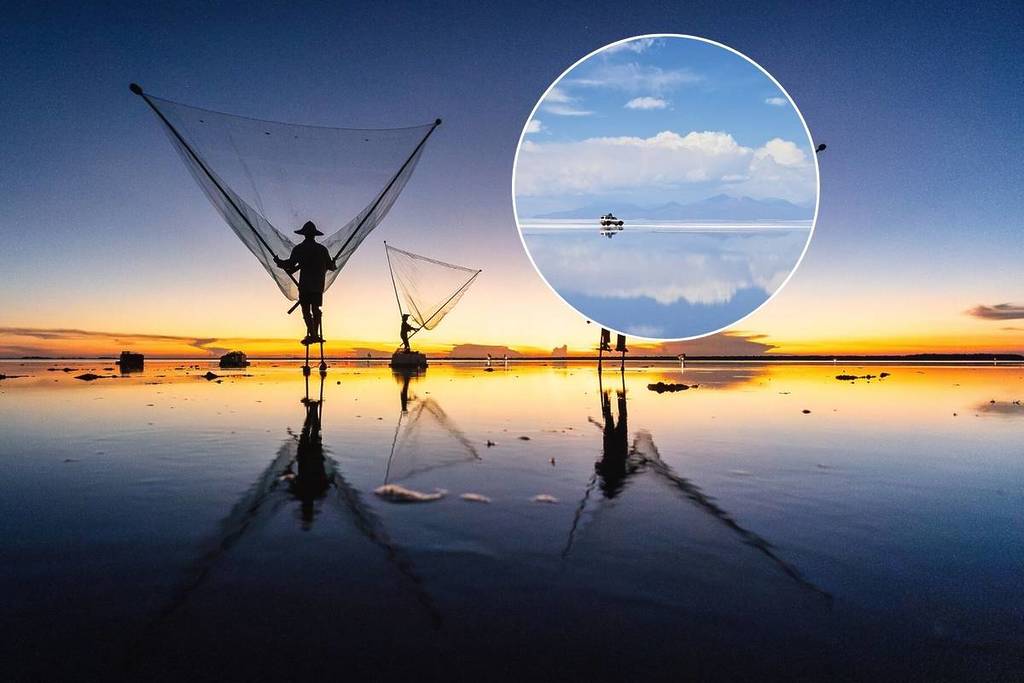
Imagine stepping onto what feels like an endless mirror that stretches beyond the horizon, where the sky and sea blend into one surreal, boundless expanse. Watch in awe as reflections ripple in soft browns and blues and the air hums around you with the gentle breeze of nature. This mysterious, otherworldly scene might make you think of the Bolivia’s magical Salar De Uyuni. But this iconic wonder isn’t in South America. It’s closer than you think. In fact, the hidden gem is a surreal beach just a few short hours from Singapore—tucked away in Vietnam. Infinity Beach in Thai Binh is relatively unknown and may be Asia’s answer to the world’s largest salt flat in Bolivia. Here’s why Infinity Beach in Vietnam is a must-visit destination.
Infinity Beach
Vietnam’s Quang Lang Beach (Biển Quang Lang), also known as Thai Binh Infinity Beach, is located just 130 kilometres from Hanoi in the Thai Binh Province. This secret beach stretches far and wide, unveiling sandy mudflats that, at low tide, create a dazzling infinity effect.
Interestingly, the gentle tide leaves the seawater ankle-deep transforming the shore into a giant, natural mirror that captures breathtaking reflects of the sky meeting the clouds. Particularly, the effect is best at dawn when the early morning light and colours deepen the surreal, infinite appearance. Overall, visitors will feel as if they are walking on water.

How does it resemble Salar de Uyuni?
The hidden mirror beach in Vietnam will remind you of Bolvia’s Salar de Uyuni in numerous ways.
Salar de Uyuni is a prehistoric lakebed formed by the evaporation of ancient lakes in Bolivia. It attracts travellers from around the world due to its shimmering landscapes, especially during the rainy season, when a thin layer of water transforms into the world’s largest natural mirror—creating spectacular reflections for photography opportunities. In fact, it’s Bolivia’s most famous tourist attraction. But how does the secret mirror beach in Vietnam rival it?

Similarly, Quang Lang Beach is known for its infinity effect creating a mirror-like scene that gives the illusion that the horizon disappears and everything is perfectly reflected—just like the Salar de Uyuni phenomenon. It offers a rare and otherworldly experience combining natural beauty, geology, and culture, making it an unmissable destination for those seeking awe-inspiring scenery in Asia.
For Asian travellers, Infinity Beach in Vietnam is a fantastic alternative to Salar de Uyuni. It’s unknown, less crowded, and offers a peaceful escape for early risers willing to trek through a mangrove forest to reach enchanting landscapes and Walking On Water illusions reminiscent of Salar de Uyuni—all without leaving Southeast Asia.
What are the key differences?
Although, the underlying natural settings differ in both locations. For instance, Salar de Uyuni is a salt flat, while Thai Binh Infinity Beach is a tidal coastal mudflat. Nevertheless, the visual experience of seeing yourself and the sky reflected on shallow water is remarkably similar at both sites. Certainly, both places are unique, instagrammable spots that continues to captivate travellers and photographers globally.
How to get there
Travellers from Singapore can hop on a quick direct flight to Hanoi. Wonderfully, it takes just three hours and 30 minutes from Changi Airport. Following this, it’s around a one hour and 30 minutes drive or train ride from Hanoi to the Thai Binh province.
SEE MORE: The Best Hidden Gems In Asia For An Off-The-Beaten-Path Adventure