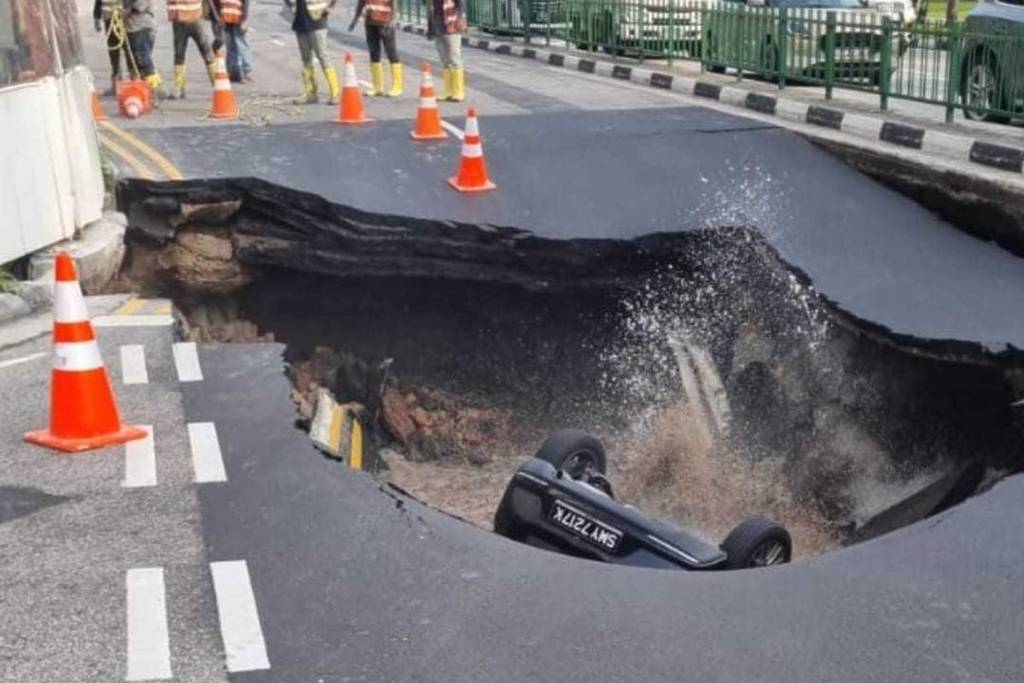
Have you ever seen a sinkhole in Singapore? On July 26, a sinkhole suddenly formed at the junction of Tanjong Katong Road South and Mountbatten Road—causing a vehicle to plunge into the hole before it filled with water. The incident happened around 5.50pm next to an active Public Utilities Board (PUB) worksite where a 16-metre deep shaft, connecting three existing sewer lines, was under construction. Read on to find out what happened with the sinkhole in Singapore.
Tanjong Katong sinkhole
The sinkhole in Singapore on July 26 appeared at the same time a concrete structural component (known as a caisson ring) in the shaft failed. As a result, this failure caused the ground above to collapse, swallowing a black car with a woman inside, and damaging two water mains. Although, the sinkhole-hit road has progressively reopened since August 2, 2025.
The female driver of the car was rescued by nearby construction workers before the Singapore Civil Defence Force (SCDF) arrived. She was transported to Raffles Hospital conscious while the emergency services and Land Transport Authority (LTA) responded promptly.
In fact, these seven workers used nylon rope to pull the woman out and they have been hailed as heroes. Following this, President Tharman Shanmugaratnam and his spouse, Ms Jane Ittogi, met with the rescue workers to thank them at Istana Open House on August 3.
The affected two lanes of the road were closed in both directions, and motorists were advised to use alternative routes, while repair and stabilization works were made. Meanwhile, preliminary checks by the Building and Construction Authority (BCA) confirmed that nearby buildings including the One Amber condominium were unaffected by the collapse.
Why did the sinkhole appear?
Experts explained that sinkholes of this nature do not form suddenly. Instead, they develop over time as soil erosion creates underground voids. This gradual erosion, possibly caused by leakage from underground pipes or disturbances from excavation works, weakens the soil and eventually leads to collapse. Visible warning signs such as cracks or water bubbling may have been subtle or missed before the incident. Therefore, the erosion process on Tanjong Katong Road likely started well before the visible collapse—making prevention and early detection challenging.
According to a media statement, PUB backfilled the shaft to stabilize the surrounding ground and is conducting an investigation into the causes of the failure. Meanwhile, a safety review was called to assess the situation and ensure the safety of similar sewer construction projections across Singapore.
SEE MORE: Understanding The Sinkholes Across Asia In Recent Times